

[The Last Express is the brainchild of Jordan Mechner]
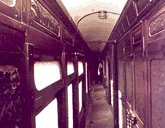
To replicate the era accurately, it was essential to find an authentic train car from the period. The problem was that the teak car pictured here ceased to be in production just prior to World War I, as after that time all cars were made of steel. And those cars that managed to survive World War I were then subject to the bombings of World War II.
 Through a network
of train buffs, however, the production team at Smoking Car
Productions was able to track down a sleeping car. A man in
France gave the team the name of a man in Italy who knew of a car
in Athens, Greece. It had lain there abandoned for some 50 years.
And now, through the magic of 3D modeling, it is about to be
brought back to life...
Through a network
of train buffs, however, the production team at Smoking Car
Productions was able to track down a sleeping car. A man in
France gave the team the name of a man in Italy who knew of a car
in Athens, Greece. It had lain there abandoned for some 50 years.
And now, through the magic of 3D modeling, it is about to be
brought back to life...
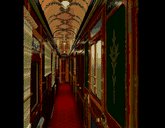 The corridor plays an important part in
the game, since so much traffic flows through it during play. In
one of the more innovative sequences in the game, characters pass
by you and seem to look you in the eye as they pass. This was
accomplished by shooting actors against a blue screen, one that
had been set up so as to match the camera angles of the filmed
walk with the angle of the 3D computer-rendered corridor.
The corridor plays an important part in
the game, since so much traffic flows through it during play. In
one of the more innovative sequences in the game, characters pass
by you and seem to look you in the eye as they pass. This was
accomplished by shooting actors against a blue screen, one that
had been set up so as to match the camera angles of the filmed
walk with the angle of the 3D computer-rendered corridor.
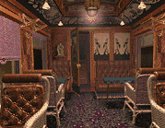
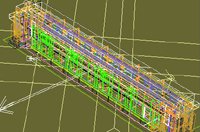
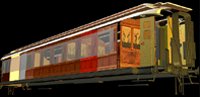
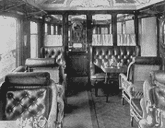 As you can see in these two images, the
accuracy and level of detail is extraordinary. By referring to
hundreds of photos taken of the actual train car, the principal
3D artist, Donald Grahame, was able to faithfully recreate the
interior,"down to the last screw." In Grahame's words,
"If you want to see how the Orient Express looked in 1914 at
the height of its period, when it became the cultural icon that
it is today, you can look at our game and say, 'That's a pretty
good guess.'" Once the wire-frame of the 3D model is
constructed, textures are mapped onto all surfaces adding
"flesh" to the digital "skeleton."
As you can see in these two images, the
accuracy and level of detail is extraordinary. By referring to
hundreds of photos taken of the actual train car, the principal
3D artist, Donald Grahame, was able to faithfully recreate the
interior,"down to the last screw." In Grahame's words,
"If you want to see how the Orient Express looked in 1914 at
the height of its period, when it became the cultural icon that
it is today, you can look at our game and say, 'That's a pretty
good guess.'" Once the wire-frame of the 3D model is
constructed, textures are mapped onto all surfaces adding
"flesh" to the digital "skeleton."

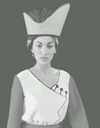
 The Art Nouveau style of the
period, lent itself well to creating a rich, detailed, and
beautiful environment for the game. To create the animated look
of the characters, actors were shot in live-action against a blue
screen. An automated process known as "Grabface" was
used to transform the thousands of frames of filmed footage into
black-and-white ink drawings which were in turn
recolored—effectively turning the actor into a human
cartoon—and composited to the 3D train environment. By going
with animated characters as opposed to digital video, the
creators of The Last Express are able to create a more
cohesive and immersive environment. As one producer put it,
"With digital video, people so often get distracted by the
actors' performances, focusing on that instead of the story.
The Art Nouveau style of the
period, lent itself well to creating a rich, detailed, and
beautiful environment for the game. To create the animated look
of the characters, actors were shot in live-action against a blue
screen. An automated process known as "Grabface" was
used to transform the thousands of frames of filmed footage into
black-and-white ink drawings which were in turn
recolored—effectively turning the actor into a human
cartoon—and composited to the 3D train environment. By going
with animated characters as opposed to digital video, the
creators of The Last Express are able to create a more
cohesive and immersive environment. As one producer put it,
"With digital video, people so often get distracted by the
actors' performances, focusing on that instead of the story.
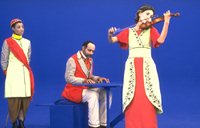
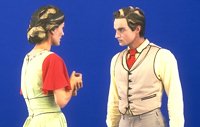 To create the seamless experience of
"being" on the train, actors are shot against a blue
screen with stand-in props that are then replaced by their
digital counterparts. Actors were cast with strong, distinctive
features that would look good if they were turned into cartoons.
To create the seamless experience of
"being" on the train, actors are shot against a blue
screen with stand-in props that are then replaced by their
digital counterparts. Actors were cast with strong, distinctive
features that would look good if they were turned into cartoons.
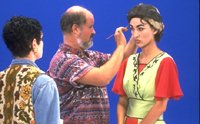
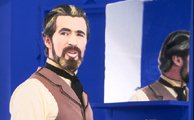 Special treatment of hair and make up
enabled the creators to fashion a distinctive look for the
characters. Actors needed to be filmed from as many as eight
different angles in order to have enough footage to accommodate
the myriad possibilities of gameplay.
Special treatment of hair and make up
enabled the creators to fashion a distinctive look for the
characters. Actors needed to be filmed from as many as eight
different angles in order to have enough footage to accommodate
the myriad possibilities of gameplay.
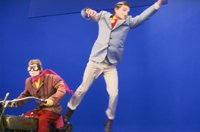 Action sequences were
accomplished in much the same way. For greater accuracy, video
compositing tools were on set to establish marks for the actors
to work.
Action sequences were
accomplished in much the same way. For greater accuracy, video
compositing tools were on set to establish marks for the actors
to work.